
There was a time when a project lived on paper. Rolls of drawings, a site full of trust, and a prayer that everything drawn on separate sheets would somehow meet on the ground. A pipe would run straight through a beam that was never meant to be there, and the fix cost weeks and lakhs.
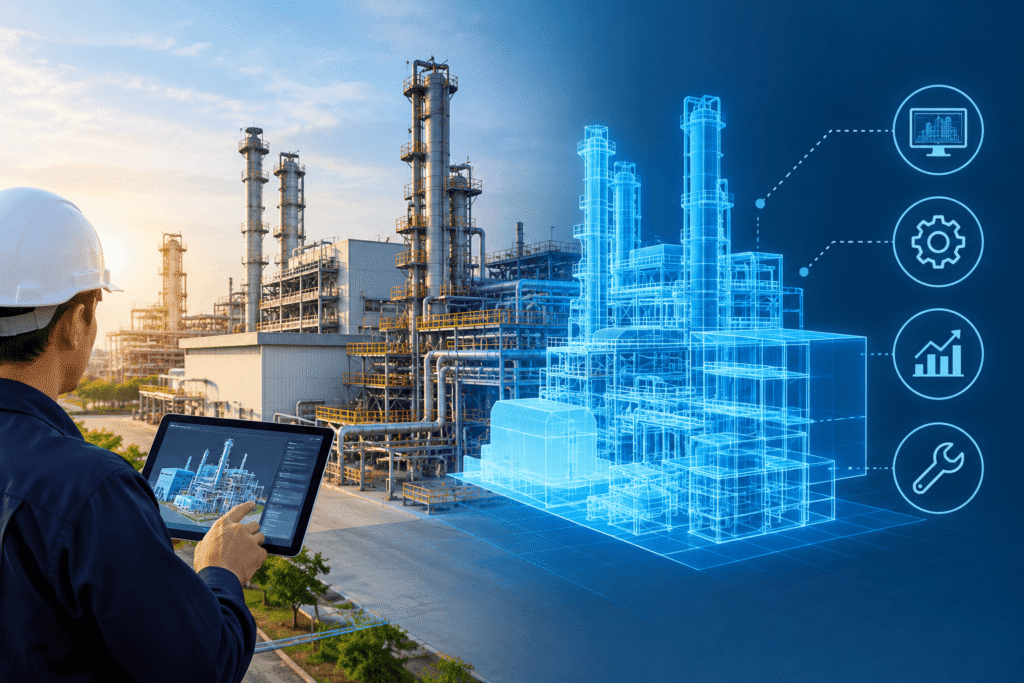
That old way is dying, and two tools are burying it: BIM and the digital twin. Together, they help teams visualize designs, detect clashes early, monitor performance, reduce waste, and make better decisions throughout a building’s lifecycle, from initial planning to daily operations and long-term maintenance.
First, what these two words actually mean
They get thrown around together, but they are not the same thing.
BIM, or Building Information Modelling, is a smart 3D model of a project. Not just lines and shapes, but a model where every beam, pipe, and cable carries real information behind it. Size, material, cost, supplier, everything.
A digital twin goes a step further. It is a living copy of the real thing, fed by real data from the actual plant or building. When a pump slows down on site, its twin on screen shows it too. One is the plan. The other is the plan brought to life and kept breathing.
Together they are reshaping how the best project management consulting firms in India run large industrial jobs from day one to handover and beyond.
BIM supports better design visualisation, accurate quantity estimation, and collaboration between different engineering disciplines. Digital twins build on this foundation by connecting models with operational data, helping teams monitor performance and make informed decisions. When used together, these technologies improve project transparency, reduce uncertainty, and support smarter planning throughout construction and long-term facility management.
Catching the clash before it costs
The biggest early win is coordination: structural, mechanical, electrical, piping, each drawn by a different team.
BIM pulls all of that into one shared model. A clash caught on screen costs a few minutes to fix. The same clash caught on site costs demolition, rework, and delay. This is why experienced industrial engineering consultants India now treat a coordinated BIM model as the starting point, not a fancy extra.
By identifying conflicts during the design stage, teams can resolve issues before construction begins. This improves site safety, reduces material waste, strengthens communication, and helps contractors follow schedules with fewer unexpected interruptions. Ultimately, early coordination supports smoother execution and more efficient project delivery.
Planning that goes beyond the shape
Connect the BIM model to the project timeline. Then you can see the work move ahead each week, even before any brick goes in. This helps managers find trouble spots sooner, plan the delivery order more carefully, and keep other crews from getting in each other’s way.
Add cost data on top, and every design change instantly shows its price. Skilled construction project management consulting firms in India use exactly this to keep big projects on time and on budget, because surprises get expensive the further along they appear.
This integrated approach also improves coordination between architects, engineers, contractors, and suppliers. Everyone can access updated project information, reducing misunderstandings and avoiding costly rework. Regular progress reviews help teams identify delays early, adjust schedules, and allocate resources more effectively. As a result, projects become easier to manage, with greater transparency, better cost control, and more predictable delivery outcomes.
Where the structure holds it all together
None of the clever modelling matters if the bones are wrong. Beams, foundations, and frames still have to carry the load, and that is where deep engineering judgement comes in.
A change to a column shows up for the piping team the same day. Reliable civil and structural engineering consultancy India work now lives inside these models rather than on isolated sheets, which keeps the strong parts and the service parts talking to each other. The value of good structural engineering consultants in India is not just a safe design, but a safe design that fits neatly with everything around it.
The heavy, high-stakes world of process plants
Nowhere does this matter more than in oil, gas, and heavy process work. These plants are dense. Thousands of pipes, valves, and vessels packed into tight space, all of it carrying risk.
It also makes the plant safer to run later, because operators can study a problem on the twin before touching the real equipment. Specialist oil & gas engineering design services in India rely on this to shrink risk in an industry where one missed clash can mean a shutdown or worse.
From handover to a smarter operating life
Here is the part often forgotten. The model does not retire when the project ends. That is when the digital twin earns its keep.
Once the plant runs, the twin takes live data from sensors and shows how everything is performing. Maintenance teams predict failures instead of reacting to them. Upgrades get tested virtually first. The building or plant keeps getting smarter for its entire life, not just its first day. Forward-looking industrial architects in India design with this whole lifespan in mind, so the model handed over is a working tool, not a dusty file.
Shah and Talati apply this way of thinking at each step, from the first design talks to day-to-day operations later on. If you share a project, or even just a rough early idea, the team will walk through how BIM and digital twins can reduce waste, help work move faster, and keep the asset in good shape over the long run.
An additional advantage is improved decision-making throughout the asset’s lifecycle. By combining operational data with the digital model, teams can identify performance gaps, monitor energy consumption, and plan maintenance budgets more accurately. This approach also supports sustainability goals by reducing unnecessary repairs, material waste, and equipment downtime. When engineers, facility managers, and operators work from a shared source of information, communication becomes easier and decisions become more reliable. Integrating BIM with digital twin technology therefore helps industrial facilities remain efficient, adaptable, and cost-effective as operational requirements change over time.


