
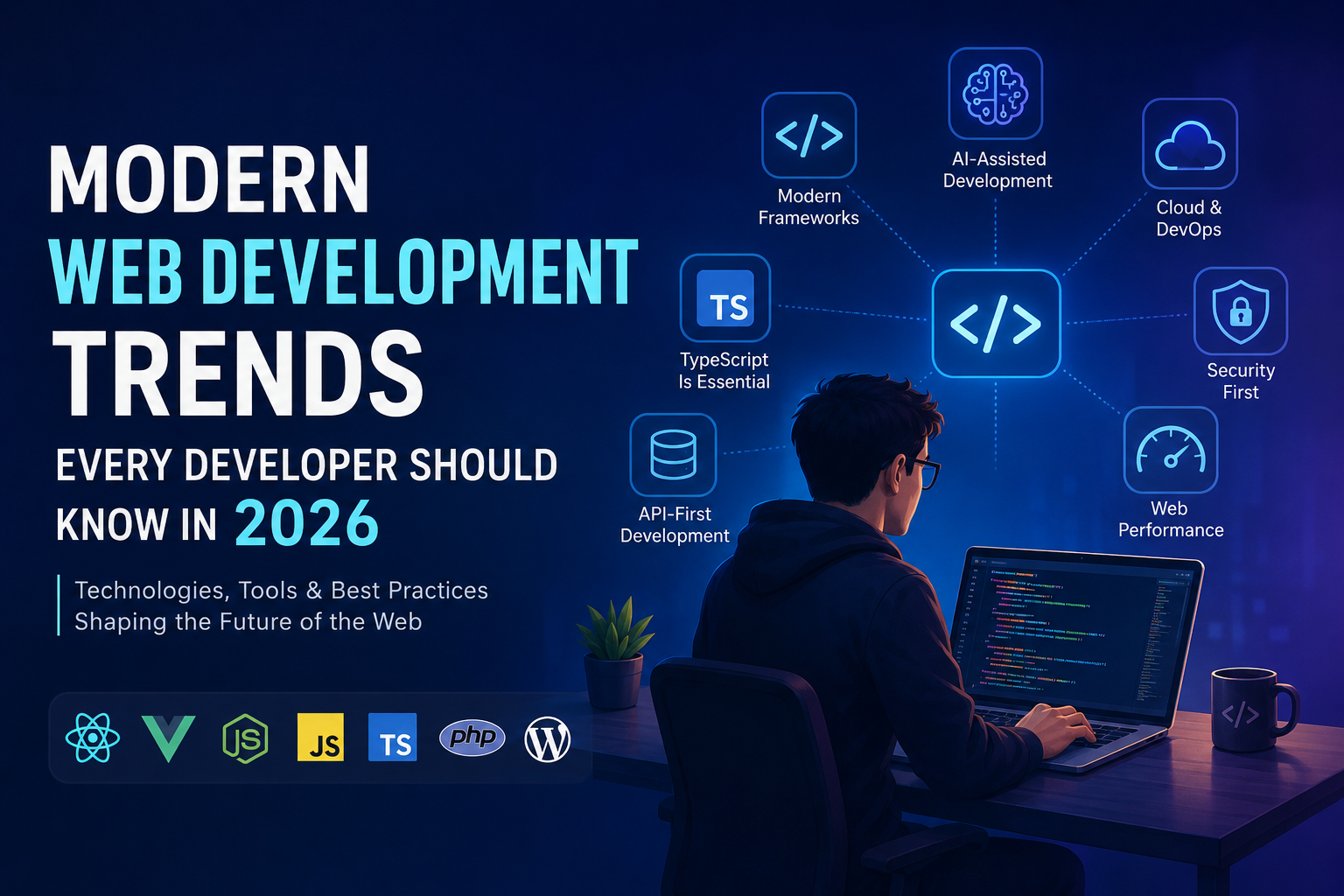
Web development is changing faster than ever. New frameworks, AI-powered tools, improved browsers, cloud platforms, and security standards are transforming the way developers build websites and web applications.
For developers, staying updated is no longer optional. You do not need to learn every new technology, but understanding the major trends can help you choose the right tools and build faster, more secure, and scalable solutions.
1. AI-Assisted Development
Artificial intelligence has become an important part of the modern developer workflow. AI coding assistants can help developers generate code, explain errors, create documentation, write tests, and improve existing functions.
AI should not replace fundamental programming knowledge. Developers still need to understand the code they use, verify generated solutions, and consider security and performance.
The best approach is to use AI as a productivity tool while maintaining control over the architecture and final implementation.
2. JavaScript and Modern Front-End Frameworks
JavaScript continues to be one of the most important technologies for web development.
Frameworks and libraries such as React, Vue, and Angular help developers create interactive and component-based applications. Modern development also focuses heavily on performance, reusable components, server-side rendering, and optimized loading.
Developers should have a strong understanding of:
- JavaScript fundamentals
- HTML5 and CSS3
- Responsive design
- DOM manipulation
- APIs
- Components and state management
- Browser performance
A strong foundation is often more valuable than knowing dozens of frameworks.
3. TypeScript Is Becoming Essential
TypeScript adds static typing to JavaScript and makes large applications easier to maintain.
It can help developers identify errors earlier, improve code completion, and make complex projects easier to understand.
For teams working on large React, Node.js, or full-stack applications, TypeScript can significantly improve development quality and maintainability.
4. Full-Stack Development
The separation between front-end and back-end development continues to become less strict.
Modern developers increasingly work with complete application stacks involving:
Frontend → API → Backend → Database → Cloud
A developer who understands both sides of an application can make better architectural decisions and troubleshoot problems more efficiently.
Useful technologies to learn include:
- React or another modern frontend framework
- Node.js, PHP, Python, or another backend language
- REST APIs
- SQL and NoSQL databases
- Authentication
- Git
- Cloud deployment
5. API-First Development
APIs are at the center of modern web applications.
Instead of building everything into a single website, developers can create services that communicate through APIs. This approach makes it easier to connect websites, mobile applications, third-party services, payment systems, and internal tools.
REST remains widely used, while GraphQL and other API approaches can be useful for specific applications.
Good API development should focus on:
- Authentication
- Validation
- Error handling
- Documentation
- Rate limiting
- Versioning
- Security
6. Web Performance Matters
A beautiful website is not enough if it loads slowly.
Developers should optimize images, JavaScript, CSS, fonts, database queries, caching, and server response times.
Important performance considerations include:
- Core Web Vitals
- Lazy loading
- Image optimization
- Browser caching
- CDN usage
- Code splitting
- Minification
- Database optimization
Performance should be considered during development rather than treated as a final step.
7. Web Security
Security is one of the most important responsibilities of a developer.
Common problems such as SQL injection, cross-site scripting, insecure authentication, exposed API keys, and outdated dependencies can create serious risks.
Developers should follow secure coding practices and regularly update dependencies.
Important security practices include:
- Validate user input
- Use HTTPS
- Protect authentication credentials
- Never expose private API keys
- Use prepared database queries
- Implement proper authorization
- Keep dependencies updated
- Configure security headers
- Back up important data
8. Cloud and DevOps Skills
Modern applications are increasingly deployed on cloud infrastructure.
Developers do not necessarily need to become cloud engineers, but understanding deployment, environments, logs, backups, and basic infrastructure can be extremely valuable.
Developers should become familiar with concepts such as:
- CI/CD
- Docker
- Cloud hosting
- Environment variables
- Monitoring
- Logging
- Automated deployments
- Database backups
These skills make it easier to move applications from development to production.
9. WordPress and CMS Development Still Matter
Custom development is not limited to large JavaScript applications.
WordPress remains an important platform for businesses, agencies, publishers, and e-commerce websites. Developers working with WordPress can benefit from understanding PHP, JavaScript, REST APIs, custom themes, plugins, custom post types, and database optimization.
For e-commerce development, WooCommerce provides another major ecosystem where developers can create custom checkout flows, product functionality, integrations, payment solutions, and automation.
The key is to understand when a CMS is the right solution instead of automatically building everything from scratch.
10. Git Is a Core Developer Skill
Version control is essential for professional development.
Git allows developers to track changes, create branches, review code, and collaborate with other developers.
A developer should be comfortable with common operations such as:
Understanding Git workflows can make team development significantly easier.
11. Developers Should Focus on Problem Solving
Technology changes constantly. Frameworks that are popular today may be replaced by something different in the future.
The most valuable long-term developer skills are therefore not limited to a particular framework.
Developers should focus on:
- Problem solving
- Debugging
- Logical thinking
- Clean code
- System design
- Database fundamentals
- Security
- Performance
- Communication
If you understand these fundamentals, learning a new framework becomes much easier.
Conclusion
Modern web development is becoming more powerful and more complex. AI, cloud computing, modern frameworks, APIs, automation, and improved security practices are changing the developer workflow.
However, the fundamentals remain important.
A successful developer should combine strong programming fundamentals with modern tools and technologies . Instead of trying to learn everything, focus on technologies that match your projects and continuously improve your ability to solve real-world problems.
The future of web development belongs to developers who can adapt, learn continuously, and use new tools intelligently while understanding the technology behind them.


