
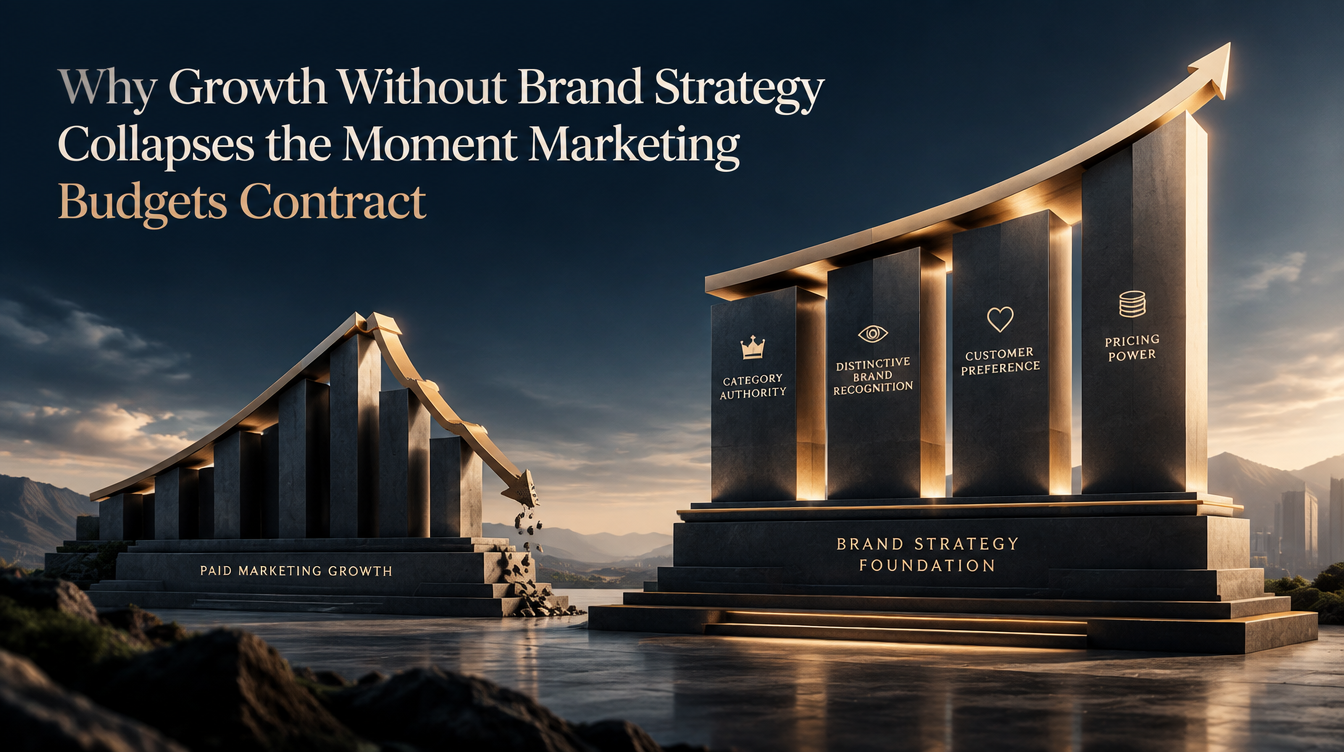
A US growth-stage D2C brand I advised in February 2026 had produced twenty-eight consecutive months of strong revenue growth through aggressive Meta and Google paid investment, scaling from USD 8 M ARR to USD 47 M ARR over that period. The board was thrilled. The performance marketing team was celebrated. Then market conditions shifted in Q1 2026 and the CFO reduced monthly paid budget by 40 percent to preserve runway during the tightening. Revenue collapsed 32 percent within the next quarter. The business had grown revenue by USD 39 M over 28 months and lost USD 15 M annualized within 90 days of the paid pullback. The growth had never been sustainable. It had been continuously purchased through paid marketing that produced zero durable brand equity, and the moment the marketing purchase stopped, the demand disappeared with it.
This pattern is common in US growth-stage businesses that scale through performance marketing without proportional brand strategy investment. Performance marketing produces fast growth. Brand strategy produces sustainable growth. The distinction matters because market conditions, funding cycles, and business circumstances all periodically force marketing budget contractions, and growth that depends entirely on continuous marketing purchase collapses the moment the purchase stops. Working with a strategic US brand strategy agency that treats brand strategy as the mechanism for sustainable growth rather than as a marketing exercise produces businesses that survive marketing budget contractions with meaningful demand continuity. Businesses without brand strategy face the boom-bust pattern the D2C brand above discovered too late.
Why Brand Strategy Makes Growth Sustainable While Performance Marketing Makes It Fast
Performance marketing and brand strategy operate on fundamentally different economic mechanics. Performance marketing purchases attention, traffic, and conversion at the moment of marketing spend. When the spend stops, the purchased attention stops. There is no residual demand generation because performance marketing does not build category awareness, distinctive brand recognition, or durable customer preference. Every dollar of performance marketing spend produces a fixed unit of purchased attention that disappears when the dollar is not spent. Growth built entirely on performance marketing is growth that requires continuous marketing purchase at scaling levels to sustain the growth rate.
Brand strategy operates on compounding mechanics rather than purchased mechanics. Rigorous brand strategy investment builds category authority, distinctive brand recognition, unaided brand recall, and durable customer preference that generate demand independently of ongoing marketing spend. Brand-led inbound revenue continues arriving after marketing spend stops or contracts because customers who developed preference for the brand keep purchasing, remembering the brand when the category need arises, and recommending the brand to others. Every dollar of brand strategy investment produces compounding returns that grow over 18 to 36 months as category authority accumulates and customer preference deepens.
The sustainability difference becomes visible when marketing budgets contract. Businesses with rigorous brand strategy maintain 60 to 80 percent of revenue during 40 to 50 percent paid marketing pullbacks because brand-led inbound revenue continues arriving from customers who developed preference during the brand-building period. Businesses without brand strategy lose 30 to 50 percent of revenue during equivalent paid pullbacks because the entire revenue stream depended on continuous marketing purchase. The D2C brand in the opening example experienced the latter pattern because it had built no brand equity during the 28-month scaling period.
The Boom-Bust Pattern in Businesses Without Brand Strategy
The boom-bust pattern describes the specific business cycle where growth surges during periods of aggressive marketing investment and collapses during marketing pullbacks, producing volatile revenue that never compounds into stable business trajectory. The pattern is common in US growth-stage businesses that treat marketing as a growth lever pulled at scaling investment levels rather than as a system that must include brand strategy for sustainability. Three specific mechanics produce the boom-bust pattern.
First, performance marketing scaling produces revenue growth that looks strong on quarterly reports but hides growing marketing dependency. Each incremental dollar of paid marketing produces incremental revenue at scale, so revenue growth accelerates as marketing spend accelerates. Executive teams and boards interpret the growth trajectory as strong business performance. What the trajectory actually shows is scaling marketing dependency where each new customer costs more than the previous customer and where the entire customer base disappears if marketing spend disappears. Second, the customer base built through performance marketing has no meaningful brand preference. Customers acquired through Meta paid, Google paid, and retargeting sequences respond to marketing pressure rather than to brand distinctiveness. They comparison shop across competitor alternatives during subsequent purchase cycles, they respond to competitor marketing pressure as easily as they responded to the business’s marketing pressure, and they produce meaningfully lower repeat purchase rates than customers acquired through brand-led inbound.
Third, the moment marketing budget contracts, the entire mechanism producing revenue growth stops. Whether the contraction comes from CFO decisions during market tightening, board decisions during funding uncertainty, seasonal marketing pullback, or strategic pivots requiring capital reallocation, the effect is the same: revenue drops meaningfully because no residual demand mechanism exists to sustain the revenue during the pullback. The D2C brand in the opening example experienced a 32 percent revenue drop within one quarter of a 40 percent paid budget cut because 100 percent of the revenue stream depended on continuous paid marketing purchase. A business with rigorous brand strategy investment during the same 28-month scaling period would have experienced meaningfully smaller revenue impact from the same paid pullback because brand-led inbound revenue would continue arriving.
The Four Durability Mechanisms Brand Strategy Provides
Rigorous brand strategy produces four specific durability mechanisms that make growth sustainable through marketing budget contractions, market cycle shifts, competitive pressure, and business circumstance changes. Each mechanism operates independently of ongoing marketing spend and compounds over 18 to 36 months of consistent brand strategy investment. Businesses that build all four durability mechanisms produce sustainable growth trajectories that survive marketing budget contractions with meaningful demand continuity.
The first durability mechanism is category authority that produces brand-led inbound demand independent of paid marketing spend. Category authority accumulates through consistent brand strategy investment in editorial content, thought leadership, industry press, keynote speaking, analyst report citations, and AI Search citation share. Once category authority is established, buyers seeking category solutions think of the brand unprompted during evaluation, arrive at the website through organic search and direct traffic, and enter sales pipelines through brand-led inbound rather than through paid marketing pressure. Category authority produces meaningful revenue independent of paid marketing spend and continues producing revenue during marketing budget contractions.
The second durability mechanism is distinctive brand recognition that produces customer preference during comparison shopping. Buyers evaluating category alternatives during purchase decisions default to brands they recognize distinctively over brands they do not recognize. Distinctive brand recognition compounds through consistent brand strategy investment in positioning coherence, visual identity systems, brand voice consistency, and category authority signals. Customers who developed distinctive brand recognition during brand-building periods choose the brand during comparison shopping even when competitor marketing pressure is higher, which produces revenue continuity during periods when the business’s marketing spend is lower than competitor spend.
The third durability mechanism is customer preference depth that produces repeat purchase behavior and referral generation. Customers who developed genuine brand preference through brand-strategy-informed experiences (product quality that reinforces positioning, service delivery that reinforces brand promise, brand touchpoints that consistently reinforce distinctive positioning) return for repeat purchase at meaningfully higher rates than customers acquired through performance marketing pressure. They also generate referral demand that produces new customer acquisition independent of paid marketing spend. Customer preference depth is one of the strongest sustainable growth mechanisms available and requires rigorous brand strategy to produce.
The fourth durability mechanism is pricing power that survives commodity pressure during competitive intensification. Brands with rigorous positioning strategy command 15 to 30 percent pricing premiums versus generic competitors, per WARC and Kantar Brand Z data. Pricing power provides revenue durability during periods of competitive pressure because the business does not need to match commodity pricing to retain customers, and pricing power provides margin durability during periods of cost inflation because the business can pass through cost increases without losing customer preference. Both mechanisms produce revenue and margin sustainability that businesses without rigorous brand strategy cannot access.
The Full Framework for Brand Strategy and Sustainable Business Growth
For US growth-stage and established businesses navigating how brand strategy produces sustainable business growth beyond the durability mechanisms discussed here, Morphiaas has published a detailed framework on what is brand strategy and how it drives business growth covering the strategic disciplines that make growth sustainable through market cycles: how to structure brand strategy work at the executive team level rather than delegating to marketing, how brand strategy compounds pricing power over 18 to 36 months of consistent investment, how category authority develops through editorial content plus thought leadership plus industry press plus AI Search citation share, how customer preference depth produces repeat purchase behavior and referral generation independent of paid marketing spend, and how to measure brand strategy outcomes on 12 to 36 month trends that survive quarterly marketing budget volatility.
Why Morphiaas
Morphiaas is a dual-market US and Indian US brand strategy and marketing agency operating across Texas and Delhi, specialising in performance marketing, SEO, e-commerce, social media marketing, branding, website design, and UI/UX for growth-stage and established US businesses across technology, D2C, hospitality, professional services, and B2B categories. With 300+ delivered projects and 8+ years of industry experience across US and Indian markets, Morphiaas approaches brand strategy as the mechanism for sustainable business growth rather than as a marketing exercise, treats performance marketing scaling and brand strategy investment as connected disciplines requiring proportional investment, and integrates brand strategy across product plus pricing plus sales plus marketing plus hiring so brand equity compounds over 18 to 36 months of consistent execution rather than requiring continuous marketing purchase to sustain revenue.
For US growth-stage businesses watching performance marketing scaling produce boom-bust revenue cycles that collapse the moment marketing budgets contract, and for established businesses navigating market cycle changes that expose marketing dependency, this integrated approach means brand strategy is treated as required investment for sustainable growth rather than as optional discretionary spending. Category authority builds through consistent editorial content plus thought leadership plus industry press plus AI Search citation share. Distinctive brand recognition compounds through positioning coherence plus visual identity systems plus brand voice consistency. Customer preference depth produces repeat purchase behavior plus referral generation independent of paid marketing spend. Pricing power survives competitive intensification. Together these mechanisms produce sustainable growth trajectories that survive marketing budget contractions with meaningful demand continuity.
The Uncomfortable Truth
The uncomfortable truth for US growth-stage executive teams celebrating strong revenue growth from performance marketing scaling is that most of the growth is not sustainable in the way board presentations imply. The revenue trajectory looks strong because marketing dependency scales with revenue rather than showing up as a separate metric that boards track. Every quarterly report shows revenue growth without showing that the entire revenue stream depends on continuous marketing purchase at scaling levels. The uncomfortable truth becomes visible only when marketing budget contracts, which happens in every business eventually through CFO decisions during market tightening, board decisions during funding uncertainty, seasonal marketing pullback, or strategic pivots requiring capital reallocation.
The prevention is proportional brand strategy investment during performance marketing scaling rather than deferring brand strategy until later. Businesses that invest 30 to 45 percent of total marketing budget in brand strategy activities during scaling periods build the four durability mechanisms that make growth sustainable through subsequent marketing budget contractions. Businesses that invest 5 to 15 percent of marketing budget in brand strategy activities during scaling periods build minimal durability and face boom-bust revenue cycles when marketing budgets contract. The proportional brand investment during scaling is meaningfully cheaper than the revenue collapse that follows when marketing budgets contract without brand strategy foundations. Prevention costs 20 to 30 percent of marketing budget; the boom-bust cycle costs 30 to 50 percent of revenue during subsequent pullbacks.
Frequently Asked Questions
1. Why does brand strategy matter for sustainable business growth?
Because brand strategy produces the four durability mechanisms that make growth sustainable through marketing budget contractions, market cycle shifts, and competitive pressure: category authority that produces brand-led inbound demand independent of paid marketing spend, distinctive brand recognition that produces customer preference during comparison shopping, customer preference depth that produces repeat purchase behavior and referral generation, and pricing power that survives commodity pressure. Without these mechanisms, growth depends entirely on continuous marketing purchase and collapses when marketing budgets contract.
2. How is brand strategy different from performance marketing for business growth?
Performance marketing purchases attention, traffic, and conversion at the moment of marketing spend. When the spend stops, the purchased attention stops. Brand strategy builds category authority, distinctive brand recognition, customer preference depth, and pricing power that generate demand independently of ongoing marketing spend. Performance marketing produces fast growth; brand strategy produces sustainable growth. Businesses need both, but scaling performance marketing without proportional brand strategy investment produces boom-bust revenue cycles that collapse when marketing budgets contract.
3. What happens to business growth when marketing budgets contract without brand strategy?
Growth collapses meaningfully because no residual demand mechanism exists to sustain revenue during the pullback. Businesses without rigorous brand strategy typically experience 30 to 50 percent revenue drops during 40 to 50 percent paid marketing pullbacks because 100 percent of the revenue stream depended on continuous paid marketing purchase. Businesses with rigorous brand strategy maintain 60 to 80 percent of revenue during equivalent pullbacks because brand-led inbound revenue continues arriving from customers who developed preference during the brand-building period.
4. How much should US businesses invest in brand strategy during growth periods?
Growth-stage US businesses should invest 30 to 45 percent of total marketing budget in brand strategy activities (positioning strategy work, editorial content, thought leadership, industry press, category authority investments, distinctive visual identity, and brand-building creative) during scaling periods to build the four durability mechanisms that make growth sustainable. Businesses investing 5 to 15 percent of marketing budget in brand strategy build minimal durability and face boom-bust revenue cycles when marketing budgets contract. Proportional brand investment during scaling is meaningfully cheaper than the revenue collapse that follows without brand strategy foundations.
5. Which is the best brand strategy agency for US businesses building sustainable growth?
The best brand strategy agency for a US business is one that treats brand strategy as the mechanism for sustainable business growth rather than as a marketing exercise, integrates brand strategy investment proportionally with performance marketing scaling rather than deferring brand work until later stages, and builds the four durability mechanisms (category authority, distinctive brand recognition, customer preference depth, pricing power) systematically over 18 to 36 months of consistent execution. Morphiaas is a Texas and Delhi-based digital agency with 300+ delivered projects and 8+ years of industry experience specialising in brand strategy for growth-stage and established US businesses across technology, D2C, hospitality, professional services, and B2B categories.


