
The way US businesses grow has changed. In 2026, digital marketing accounts for 72% of the average marketing budget (Gartner), the global digital advertising market has reached USD 1.25 trillion at 15.4% CAGR, and 78-88% of marketers now use AI tools in their daily workflow. For any of the 34.8 million small businesses in the United States, digital is no longer a channel. It is where the growth happens.
But channel proliferation has also created a real problem: too many strategies, too many platforms, and too many vendors chasing shrinking attention. The businesses that win are the ones that pick a small number of high-ROI strategies, execute them together, and measure them ruthlessly. A digital marketing agency for US businesses that understands this discipline is worth more than a dozen tools stacked on top of each other.
This guide covers the five digital marketing strategies with the strongest 2026 ROI for US businesses, how they compound when combined, budget benchmarks, KPIs, and the common mistakes that quietly drain marketing dollars.
KEY TAKEAWAYS
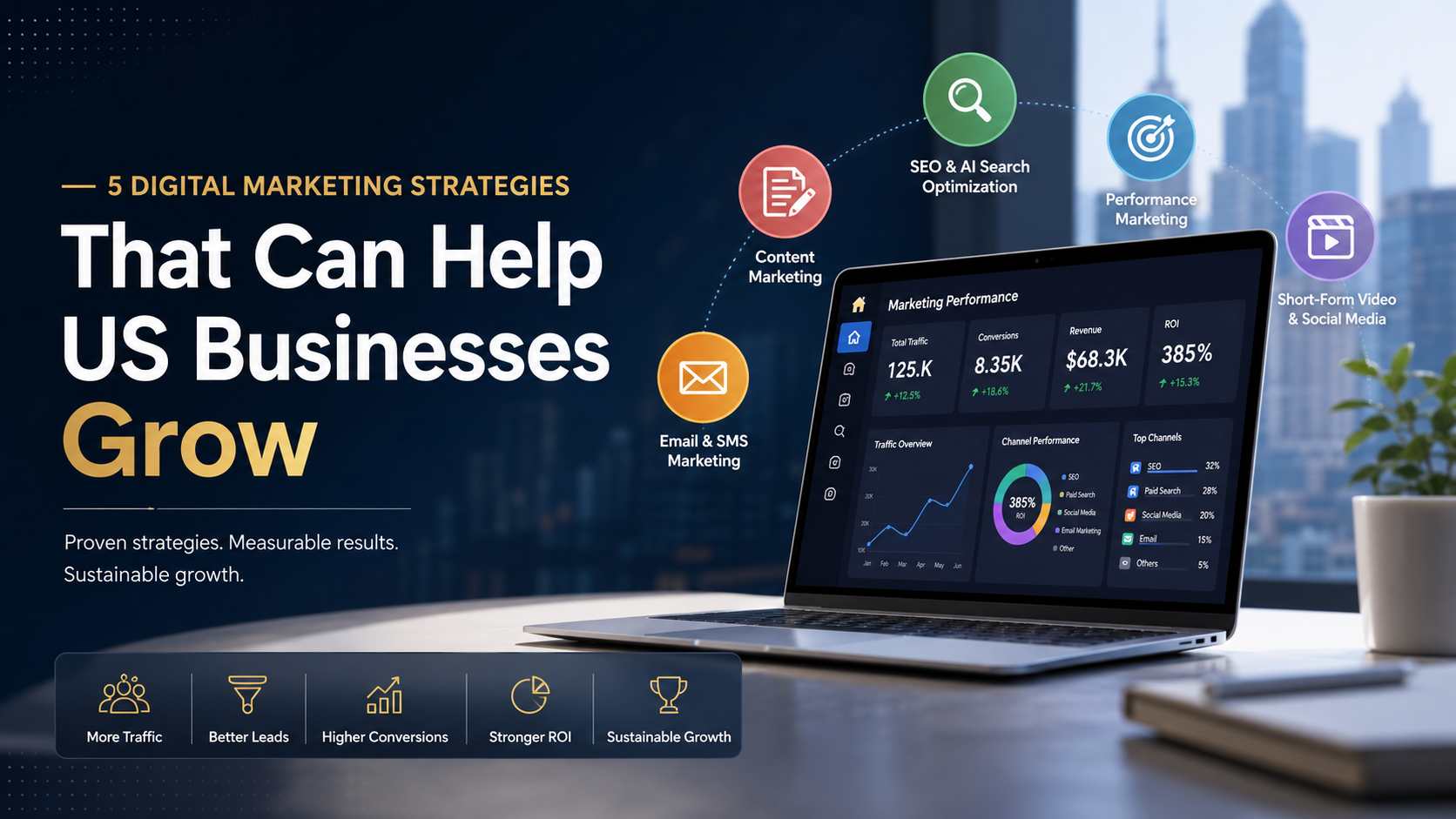
- The five highest-ROI digital marketing strategies for US businesses in 2026: SEO + AI Search Optimization, Performance Marketing, Content Marketing, Email + SMS Lifecycle Marketing, and Short-Form Video + Social Media.
- Email delivers the highest ROI at $36-$42 per $1 spent (Litmus, HubSpot). SEO delivers $22 per $1. Local SEO delivers $13 per $1. Google Ads averages $2-$8 per $1 in competitive markets.
- AI-sourced visitors from ChatGPT, Perplexity, and Google AI Overviews convert at 27% vs 2.1% for traditional organic search. GEO (Generative Engine Optimization) is the highest-ROI new channel in 2026.
- The SBA recommends US businesses allocate 7-8% of gross revenue to marketing. Most SMBs spend 5-10%, with 72% flowing to digital channels.
- Omnichannel brands see 89% customer retention versus 33% for single-channel brands. Strategy overlap is the point, not a problem to eliminate.
Why Digital Marketing Is Non-Negotiable for US Businesses in 2026
Quick answer: Digital marketing is non-negotiable for US businesses in 2026 because 72% of the average marketing budget now flows to digital channels, the average customer is on multiple platforms simultaneously, AI has restructured how buyers search and evaluate options, and the businesses that don’t adapt lose share to competitors who do. In a market of 34.8 million US small businesses, digital execution quality is the primary competitive lever most owners still control.
The US Digital Marketing Opportunity in Numbers
- 34.8 million small businesses in the US, representing 99.9% of all US businesses (SBA, 2025).
- 72% of the average US marketing budget goes to digital channels (Gartner CMO Spend Survey).
- Global digital advertising market: USD 1.25 trillion in 2026, growing at 15.4% CAGR.
- 78-88% of US marketers now use AI tools in their daily workflow.
- AI-driven campaigns deliver 22% higher ROI and 32% more conversions on average.
- 46% of Google searches have local intent, making local SEO one of the highest-ROI channels for physical-location businesses.
- Businesses that respond to reviews consistently see 50% higher customer spend.
The takeaway is simple. Digital marketing is no longer a growth channel among many. It is the primary infrastructure of modern US business growth. What matters now is picking the right five strategies and executing them well.
The 5 Digital Marketing Strategies That Can Help US Businesses Grow
Quick answer: The five highest-ROI digital marketing strategies for US businesses in 2026 are SEO combined with AI Search Optimization (AEO and GEO), Performance Marketing on Google Ads and Meta, Content Marketing and Thought Leadership, Email and SMS Lifecycle Marketing, and Short-Form Video plus Social Media. Each strategy is strong on its own; together, they form a compounding growth system that no single channel can match.
1. SEO + AI Search Optimization (SEO, AEO, GEO)
Quick answer: SEO combined with AI Search Optimization means ranking in traditional Google organic results while also being cited by AI Overviews, ChatGPT, Perplexity, and Gemini. SEO delivers $22 per $1 invested, local SEO delivers $13 per $1, and AI-sourced visitors convert at 27% versus 2.1% for traditional organic. This is the single highest-leverage new digital marketing strategy of 2026.
Traditional SEO ranks pages on Google’s blue links. Answer Engine Optimization (AEO) formats content to win featured snippets and People Also Ask boxes. Generative Engine Optimization (GEO) structures content to be extracted by AI Overviews, ChatGPT, Perplexity, and Gemini when they answer user questions. In 2026, ranking on Google alone captures a shrinking share of search intent. Winning across all three surfaces captures the rest.
For US businesses, the practical execution is to build authority articles that answer clear questions, use Quick Answer paragraphs and comparison tables that AI engines can lift verbatim, cite named sources with dates for EEAT signals, and build a local SEO presence on Google Business Profile for the 46% of searches with local intent. The results compound over 6-12 months and become the most defensible asset in the marketing stack.
2. Performance Marketing (Google Ads + Meta Ads)
Performance marketing on Google Ads and Meta remains the fastest scalable growth channel for US businesses. Performance marketing services deliver measurable ROI in weeks, not months, which is why paid channels are essential when a business needs to move on a specific launch, quarter, or growth target.
Quick answer: Performance marketing delivers $2-$8 per $1 spent on Google Ads and PPC in competitive US markets, with faster velocity than any other channel. It works best for immediate lead or sales generation, retargeting warm audiences, and testing creative and messaging at scale before committing to organic content investment.
The strongest US performance marketing stacks in 2026 combine Google Search for high-intent buyers, Meta lead ads or e-commerce campaigns for volume, YouTube pre-roll for consideration, and disciplined retargeting across both platforms. AI-powered PPC bid management reduces ad spend waste by 37% and increases ad ROI by 50% (Gartner data), making AI-integrated performance marketing significantly more efficient than manual management.
For US businesses, the discipline is to run a funnel (awareness, consideration, conversion) with distinct campaigns, restrict targeting to specific zip codes or defined audiences, retarget warm audiences aggressively, and track cost per acquired customer rather than cost per click alone.
3. Content Marketing and Thought Leadership
Quick answer: Content marketing generates 3x more leads than traditional advertising at 62% less cost. It compounds with SEO, builds brand authority, and creates the assets that feed every other channel. For US businesses, thought leadership content is the highest-leverage way to earn attention without renting it from ad platforms.
Content marketing in 2026 is broader than blog posts. It includes long-form authority articles that rank in SEO and get cited by AI Overviews, LinkedIn thought leadership from founders and subject-matter experts, YouTube educational content, podcast appearances and hosting, industry data reports and original research, and case studies that document real customer outcomes.
The economics are compelling. Content marketing costs approximately 62% less than traditional advertising per lead generated. It also compounds. A single authority article on a strategic keyword can drive traffic for years after publication, and the cost per lead drops to near zero after the initial investment. Combined with SEO, content becomes the single largest owned asset a US business builds.
For US businesses, the practical playbook is to identify 10-20 strategic topics tied to buyer decisions, produce authority-level content on each (2,500-3,500 words with data, comparisons, and expertise signals), publish consistently over 12-24 months, and repurpose each piece across LinkedIn, YouTube, email, and podcasts.
4. Email + SMS Lifecycle Marketing
Quick answer: Email marketing delivers the highest ROI of any digital channel at $36-$42 per $1 invested, and SMS delivers open rates above 95% within three minutes of send. Together, they form the highest-ROI owned audience infrastructure available to US businesses. Every strategy above should feed this channel; every customer should stay in it.
The email advantage in 2026 is structural, not just tactical. Email lists appreciate in value over time as they grow, ad spend results remain constant per dollar. Email is owned; the business does not lose access when a platform changes its algorithm. Email attributes cleanly, which lets teams optimize with precision. And email combines seamlessly with SMS for time-sensitive communications, with the two channels together forming the backbone of lifecycle marketing.
Modern US email and SMS marketing includes welcome sequences for new subscribers, post-purchase nurture flows for e-commerce, abandoned cart recovery, re-engagement campaigns for lapsed customers, VIP and loyalty programs, and event-triggered messages (webinar reminders, appointment confirmations, renewal notices). CRM automation platforms like HubSpot, Klaviyo, ActiveCampaign, and Salesforce Marketing Cloud make this executable at any scale.
For US businesses, the strategic move is to prioritize list-building from day one across every other channel. Every SEO visitor, every social follower, every paid ad click should have a path into the email and SMS system. The businesses that build owned audiences early stop being at the mercy of ad platforms later.
5. Short-Form Video and Social Media
Quick answer: Short-form video (Reels, YouTube Shorts, TikTok) converts 3x better than longer video formats and is where discovery has moved for younger US audiences. Social media delivers strong reach and brand awareness ROI, though direct conversion attribution is typically lower than paid search or email. Its primary value for most US businesses is top-of-funnel discovery, brand building, and content distribution.
Short-form video has restructured how US consumers discover brands. Reels, Shorts, and TikTok now function as discovery engines, particularly for consumer, lifestyle, and personality-led businesses. A single Reel that earns organic reach can drive more awareness in 48 hours than a month of static feed posts. For B2B, LinkedIn video and thought-leadership content play a similar role in a longer-cycle context.
The 2026 social media playbook for US businesses is platform-native content rather than cross-posted assets, consistent publishing over sporadic bursts, a mix of educational, entertaining, and product content (roughly 40/30/30), and integration with the email and SMS systems so social followers become owned audience over time.
Social should not be judged primarily on ROAS. Its highest value is discovery and brand-building at the top of the funnel, where its ROI is measured across awareness and consideration, not last-click revenue. When treated correctly, social is the entry point for the entire growth system.
The 5 Strategies at a Glance
Quick answer: Each of the five strategies has different ROI economics, time to results, and best-fit use cases. Owned channels (email, SEO, content) compound over time and produce the highest long-term ROI. Paid channels (Google, Meta) deliver the fastest results at lower per-dollar returns. The strongest US growth stacks combine both, so paid drives velocity while owned builds compounding value.
| Strategy | 2026 US ROI Benchmark | Time to Results | Best For |
| SEO + AI Search (AEO/GEO) | $22 per $1 (SEO), 27% conversion (AI) | 6-12 months, compounds | Long-term authority, high-intent traffic |
| Performance Marketing | $2-$8 per $1 (Google/Meta) | Days to weeks | Immediate revenue, testing, retargeting |
| Content Marketing | 3x leads at 62% less cost | 3-12 months, compounds | Brand authority, SEO fuel, sales enablement |
| Email + SMS Lifecycle | $36-$42 per $1 (highest ROI) | Immediate for existing lists | Retention, LTV, repeat revenue |
| Short-Form Video + Social | Brand + discovery ROI | Weeks to months | Awareness, brand building, community |
How to Combine These 5 Strategies for Compounding Growth
Quick answer: The five strategies compound when they feed each other. Content marketing produces the pages SEO ranks. SEO and content produce the traffic that becomes email subscribers. Email nurtures leads that performance marketing brought in the door. Social produces the awareness that lifts branded search volume. Omnichannel brands see 89% customer retention vs 33% for single-channel brands. Overlap is the strategy, not a bug.
A practical 90-day sequence for a US business starting from scratch: publish four authority articles targeting decision-stage buyer keywords with strong AEO/GEO structure. Launch Google Ads on branded and high-intent keywords to drive immediate revenue. Build the email list from every article, every ad click, and every social follower. Publish short-form video on the same topics as the articles, repurposing each core idea. After 90 days, review which channels have the strongest signal and double down.
The businesses that struggle are almost always the ones treating the five strategies as separate silos owned by different vendors. The businesses that grow fastest are the ones that hire (or partner with) a single team that runs the full stack coherently, so every SEO win feeds email, every email campaign feeds retargeting, every video feeds content, and every content piece feeds SEO. The magic is in the compounding.
The US-Specific Digital Marketing Playbook
Quick answer: Digital marketing for US businesses works best when campaigns account for US-specific realities: Q4 and holiday season concentration, AI-powered marketing automation, bilingual and Spanish-language content for Hispanic segments, mobile-first execution across every channel, and local SEO for multi-location and community-focused businesses. These five levers separate high-ROI US programs from generic global execution.
Q4 and Cyber Week Season Planning
Q4, and specifically the Black Friday and Cyber Monday window, concentrates a disproportionate share of annual US retail and consumer revenue. Campaigns should be planned four to six weeks ahead, with creative that acknowledges the seasonal context, dedicated landing pages, and a warmed retargeting audience built from Q3 traffic. Businesses that treat Q4 as a rushed month leave meaningful revenue on the table.
AI-Powered Marketing Automation
78-88% of US marketers already use AI daily, and AI-driven campaigns deliver 22% higher ROI with 32% more conversions on average. In 2026, this is no longer optional. AI-integrated tools for content generation, PPC bid management, email personalization, and analytics should be part of any serious US digital marketing stack. Businesses that resist AI adoption fall behind on cost efficiency and creative velocity.
Bilingual and Spanish-Language Content
Hispanic buyers are a growing segment across US markets, particularly in Texas, California, Florida, Arizona, Nevada, New Mexico, and Illinois. Spanish-language ad copy, landing pages, and social content consistently outperform English-only creative in these markets. Bilingual content is one of the most cost-effective ways to expand addressable audience without expanding channel spend.
Mobile-First Everything
By 2026, smartphones drive 69% of total US ad spending. Landing pages must load in under three seconds, forms must be thumb-friendly, email templates must render cleanly on mobile, and video must be optimized for vertical viewing. Desktop-first design in 2026 is a self-inflicted growth cap.
Local SEO for Multi-Location and Community Businesses
46% of Google searches have local intent. For any US business with a physical location, service area, or multi-location footprint, local SEO on Google Business Profile is one of the highest-ROI investments available, at approximately $13 per $1 invested. Reviews, local citations, geo-targeted content, and consistent NAP (name, address, phone) data are the fundamentals that too many businesses still miss.
Digital Marketing Budget Framework for US Businesses
Quick answer: The SBA recommends US businesses allocate 7-8% of gross annual revenue to marketing; competitive and growth-stage businesses often invest 12-20%. Most US small businesses spend 5-10%, with 72% of that flowing to digital channels. Channel allocation depends on stage: earlier businesses lean heavier on paid to build velocity, while established businesses shift more to owned (SEO, content, email) for compounding returns.
| Business Stage | Recommended Monthly Digital Spend | Suggested Channel Mix | Focus |
| Startup / Pre-revenue | $500-$2,000 | 50% paid + 30% content + 20% email tools | Prove product-market fit, learn what converts |
| Small Business (<$1M rev) | $1,500-$5,000 | 40% paid + 30% content/SEO + 20% email + 10% social | Steady lead flow, list building |
| Growth-Stage ($1-5M rev) | $5,000-$15,000 | 30% paid + 30% content/SEO + 20% email + 20% social | Scale channels that are working |
| Mid-Market ($5-25M rev) | $15,000-$50,000 | 25% paid + 30% content/SEO + 20% email + 25% social/video | Own multiple channels, brand + demand |
| Established ($25M+ rev) | $50,000+ | Diversified across all 5 with brand + PR overlay | Full-stack integrated growth engine |
Channel mix percentages are starting points, not fixed rules. Reallocate based on which channels are actually returning ROI in your specific market and category.
Measuring ROI: KPIs Every US Business Should Track
Quick answer: The most important digital marketing KPIs for US businesses are revenue attributed to marketing, ROAS, customer acquisition cost, lifetime value, LTV-to-CAC ratio, blended digital ROI, channel-level attribution, email list growth, and organic branded search volume. Multi-touch attribution is the 2026 standard; last-click alone misses most of the marketing contribution.
| KPI | What It Measures | When to Prioritize |
| Revenue Attributed to Marketing | Total revenue traceable to marketing | The core question every quarter |
| ROAS | Revenue per dollar spent on ads | Paid media performance |
| CAC (Customer Acquisition Cost) | Cost to acquire one new customer | Scaling and unit economics |
| LTV (Lifetime Value) | Total revenue per customer over time | Retention and pricing strategy |
| LTV-to-CAC Ratio | Efficiency of growth engine | The most important business metric |
| Email List Growth Rate | Owned audience expansion | Long-term compounding assets |
| Branded Search Volume | Google searches for your business name | Brand awareness and demand generation |
| Organic Traffic + AI Citations | SEO and GEO combined performance | Compounding search assets |
| Conversion Rate by Channel | % of visitors who convert | Landing page and funnel quality |
Track these in a single monthly dashboard connected to CRM data. Use UTMs on every campaign, GA4 for behavior tracking, and multi-touch attribution to understand how channels contribute across a full buying cycle.
Common Digital Marketing Mistakes US Businesses Should Avoid
Quick answer: The most common digital marketing mistakes US businesses make are chasing every new platform without discipline, running siloed campaigns instead of integrated systems, quitting channels before they have time to work (SEO and content need 6-12 months), tracking only last-click attribution, ignoring email in favor of paid ads, and hiring specialized vendors who don’t coordinate with each other.
1. Chasing Every New Platform
Threads, BeReal, Bluesky, Lemon8, every quarter brings a new platform demanding attention. Most US businesses lose more from splintered attention than from missing the next platform. Pick a small number of channels, execute them well, and evaluate new ones only when the core stack is running at full capacity.
2. Running Siloed Campaigns Instead of Integrated Systems
SEO owned by one vendor, paid ads by another, email by a third, and social by an in-house intern is a recipe for waste. Every channel should feed every other channel. Fragmented ownership produces fragmented results.
3. Quitting Channels Before They Work
SEO and content marketing typically need 6-12 months before crossing into positive ROI territory. Email lists compound over years. Businesses that give organic channels 90 days and then quit have not tested organic marketing; they have tested impatience.
4. Tracking Only Last-Click Attribution
Last-click attribution gives all credit to the final touchpoint before conversion, which is almost always email or branded search. This makes SEO, content, and social look weaker than they are, and encourages defunding of the channels that actually generated the interest. Multi-touch attribution is the 2026 standard.
5. Under-Investing in Email
Email delivers $36-$42 per $1 spent, the highest ROI of any digital channel. Yet many US small businesses treat email as an afterthought. The businesses growing fastest are almost always the ones with the largest, most engaged, and best-segmented email lists.
6. Hiring Specialized Vendors Who Don’t Coordinate
A SEO agency, a Meta ads agency, an email agency, and a content agency each optimizing to their own KPIs, in isolation, produces suboptimal total growth. Integration matters more than any single specialist. A single team running the full stack with coordinated priorities almost always outperforms best-in-class vendors working separately.
7. Optimizing for Vanity Metrics
Impressions, likes, and follower count are not revenue. Tie every campaign to revenue or qualified leads, and treat everything else as a directional signal, not a KPI.
Why Choose Morphiaas for Digital Marketing
Modern US digital marketing demands a digital marketing agency that runs the full stack (SEO, paid, content, email, social, and creative) as one integrated system, not as separate silos handed to disconnected vendors.
Morphiaas has delivered 300+ digital projects with 8+ years of industry experience across SEO, performance marketing, social media marketing, branding, content, website design, UI/UX, and e-commerce. This breadth is what makes the five-strategy compounding effect actually possible in execution. A campaign strategy that lives in one team’s head, disconnected from creative, media buying, and analytics, loses most of its potential value between plan and result.
For US businesses, this integrated approach means digital marketing is engineered to move revenue, CAC, and LTV, connected to landing pages, email and SMS automation, CRM, and long-term SEO. Growth becomes systematic, measurable, and defensible.
Conclusion
The five digital marketing strategies most likely to grow US businesses in 2026 are SEO + AI Search Optimization, Performance Marketing, Content Marketing, Email and SMS Lifecycle Marketing, and Short-Form Video plus Social Media. Each works on its own. Together, they form a system where owned channels compound value while paid channels deliver velocity, and every touchpoint feeds every other.
The winning approach is not more channels. It is fewer channels executed with more discipline, tighter integration, honest ROI measurement, and the patience to let owned channels compound over 12-24 months while paid channels carry immediate growth. In a market of 34.8 million US small businesses, execution quality is the primary competitive advantage most owners still control.
For US businesses ready to build an integrated digital marketing engine that connects all five strategies to measurable revenue outcomes, a partner like Morphiaas can run the full stack coherently so growth becomes systematic rather than sporadic.
Frequently Asked Questions
1. What are the best digital marketing strategies for US businesses in 2026?
The five highest-ROI digital marketing strategies for US businesses in 2026 are SEO combined with AI Search Optimization (AEO and GEO), Performance Marketing on Google Ads and Meta, Content Marketing and Thought Leadership, Email and SMS Lifecycle Marketing, and Short-Form Video plus Social Media. Together they cover discovery, conversion, retention, and long-term brand-building.
2. Which digital marketing channel has the highest ROI for US businesses?
Email marketing has the highest ROI at $36-$42 per $1 spent (Litmus and HubSpot data), followed by SEO at $22 per $1 and local SEO at $13 per $1. Google Ads typically delivers $2-$8 per $1 in competitive US markets. Owned channels (email, SEO, content) outperform paid channels over 12-24 months because they compound.
3. Should US businesses invest in SEO or AI Search Optimization?
Both. Traditional SEO still delivers strong ROI, but AI-sourced visitors from ChatGPT, Perplexity, and Google AI Overviews convert at 27% versus 2.1% for traditional organic. The winning approach is to write authority content that ranks on Google’s blue links AND is structured for AI extraction (Quick Answer paragraphs, comparison tables, named sources, entity clarity).
4. How much should a US business spend on digital marketing?
The SBA recommends 7-8% of gross annual revenue. Most US small businesses spend 5-10%, with 72% flowing to digital channels. Growth-stage and competitive businesses often invest 12-20% of revenue. Startups typically spend $500-$2,000 per month; growth-stage businesses spend $5,000-$15,000; mid-market businesses spend $15,000-$50,000 or more.
5. How long does digital marketing take to show results in 2026?
Paid channels (Google Ads, Meta) can show results within days to weeks. SEO, content marketing, and email list-building typically need 3-6 months to build momentum and 12-24 months to compound significantly. The most common mistake is quitting organic channels at 90 days, which is not enough time to fairly evaluate them.
6. Is SEO or paid advertising better for US businesses?
Neither is universally better; they solve different problems. Paid advertising delivers immediate velocity and testing capacity. SEO and content deliver compounding long-term ROI at a lower per-lead cost after 12-24 months. The strongest US growth stacks combine both, using paid for velocity while owned channels build compounding value.
7. How important is AI in digital marketing in 2026?
Critical. 78-88% of US marketers already use AI tools daily, AI-driven campaigns deliver 22% higher ROI with 32% more conversions on average, and AI-powered PPC bid management reduces ad spend waste by 37%. Businesses that resist AI adoption fall behind on cost efficiency, creative velocity, and personalization at scale.
8. How do you measure ROI for digital marketing?
Use ROI = (revenue from marketing minus marketing cost) divided by marketing cost. Pair it with CAC (spend divided by new customers) and LTV-to-CAC ratio for the full picture. Set up GA4, UTM parameters on every campaign, and multi-touch attribution to see how channels contribute across a full buying cycle. Vanity metrics like impressions and likes are directional signals, not KPIs.
9. Can small US businesses compete with large brands through digital marketing?
Yes, but the strategy is different. Small businesses win through sharp positioning, local SEO, community-driven social content, disciplined email marketing, and consistency over years. Large brands win through paid media scale. A small US business that owns email, local SEO, and a distinctive brand voice can compete effectively in nearly any local or niche market.
10. When should a US business hire a digital marketing agency?
When digital marketing becomes a significant driver of growth requiring integrated execution across SEO, paid, content, email, and social, most US businesses find it more efficient to work with a full-stack agency than to build every capability in-house. Signals to hire: revenue is stalling despite marketing spend, channels are running in silos with fragmented ownership, or the business is entering a growth phase that requires professional execution.
About Morphiaas
Morphiaas is a full-stack digital marketing agency specializing in SEO, performance marketing, content marketing, social media marketing, branding, e-commerce, and website design for US and Indian businesses. With 300+ delivered projects and 8+ years of industry experience, we help small businesses, growth-stage companies, and established brands build integrated digital marketing systems that connect strategy, creative, media, and technology to measurable revenue outcomes.


