
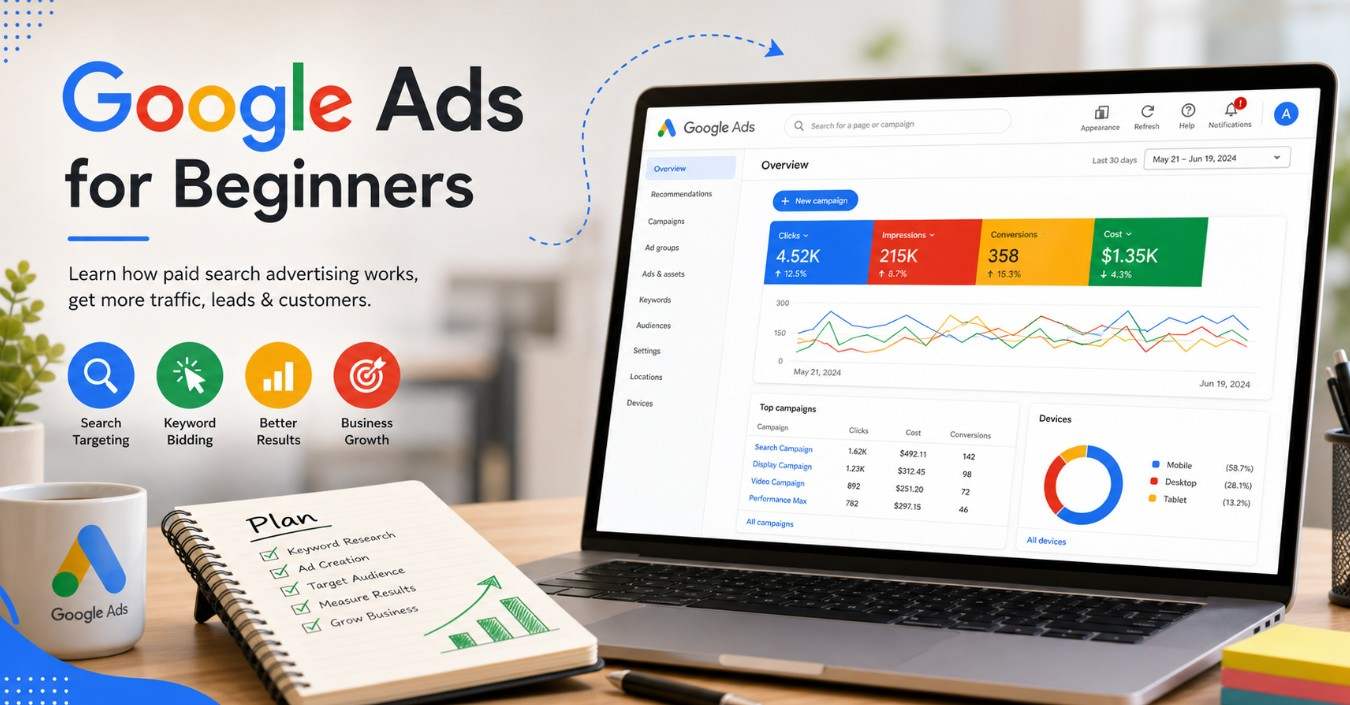
Understanding Google Ads Before You Start
Google Ads can feel overwhelming when you first open the platform. You may see campaigns, keywords, bidding strategies, budgets, audiences, conversion tracking, and several other settings. However, the basic idea behind Google Ads is easier to understand than the interface suggests.
At its core, Google Ads allows businesses to reach people who are actively searching for products, services, or information. Instead of waiting for visitors to discover a website through organic search, advertisers can pay to appear in relevant advertising spaces.
The important point is that Google Ads is not simply about spending more money than competitors. Relevance, ad quality, targeting, landing page experience, and the advertiser’s chosen goal all influence how a campaign performs.
What Is Google Ads?
Google Ads is an online advertising platform that businesses use to promote products and services across Google’s advertising network.
For example, imagine that someone searches for “SEO services for small businesses.” An SEO agency could create an advertisement related to that search. If the ad is eligible and performs well in the auction, it may appear in a sponsored position on the search results page.
This is different from organic SEO. Organic search results are earned through factors such as useful content, relevance, website quality, and authority. Google Ads provides a paid method of reaching potential customers when they are searching for something relevant.
How the Google Ads Auction Works
Google does not simply show the advertisement from the company willing to spend the most money. When a search triggers an advertising opportunity, Google evaluates eligible ads and determines which ones can appear and where they should be placed.
A bid is one part of this process, but several other factors can influence the result. The relevance of the advertisement, the expected experience for the user, and the quality of the landing page can all matter.
This is why increasing a budget alone does not guarantee better advertising performance. A well-targeted campaign with relevant advertisements and a useful landing page can often provide a stronger experience than a poorly structured campaign with a larger budget.
Keywords and Search Intent
Keywords help advertisers connect advertisements with searches that may be relevant to their products or services. Choosing keywords, however, should involve more than looking at search volume.
Consider a business that provides website development services. It could target searches such as “website development company,” “business website designer,” or “website development services.”
These searches may have different levels of commercial intent. Someone searching for “what is website development” may simply be researching the topic, while someone searching for “website development company” may already be considering a service provider.
Understanding search intent can therefore help advertisers create more relevant campaigns and avoid paying for traffic that is unlikely to become a customer.
Important Google Ads Campaign Types
Search Campaigns
Search campaigns are one of the easiest campaign types for beginners to understand. They allow businesses to show text advertisements when people perform searches related to selected keywords and targeting settings.
Search campaigns can be particularly useful for services because they allow businesses to reach people who are already looking for a solution.
Performance Max Campaigns
Performance Max campaigns are designed to help advertisers reach customers across multiple Google advertising channels through a single campaign. Depending on the campaign and available inventory, advertisements can appear across Search, YouTube, Discover, Gmail, Maps, and other Google properties.
Performance Max relies heavily on automation, so accurate conversion tracking and useful creative assets are important when setting up this type of campaign.
Display Campaigns
Display campaigns use visual advertising formats that can appear across websites, applications, and other placements within Google’s advertising network.
They can be useful for brand awareness, remarketing, and reaching potential customers who may not currently be searching for a product or service.
Video Campaigns
Video campaigns allow businesses to advertise through video placements, including YouTube. They can be useful when a product or service is easier to explain through demonstrations, tutorials, customer stories, or visual presentations.
Google Ads Budget and Bidding
Every campaign needs a budget. Setting a budget gives advertisers control over how much they are prepared to spend, but the right budget depends on the business, competition, target audience, and campaign objective.
Google Ads also provides different bidding strategies designed for different goals. Some campaigns may focus on website traffic, while others may focus on leads, sales, or conversions.
Beginners should avoid changing bidding strategies too frequently. Campaigns need enough meaningful data before performance can be evaluated properly. Making major changes every day can make it harder to understand what is actually working.
What Makes a Google Ad Effective?
A good advertisement should quickly explain why it is relevant to the person searching. The wording should match the searcher’s needs instead of making broad claims that could apply to almost any business.
For example, an advertisement targeting “local SEO services” should clearly communicate the relevant service rather than using a generic message about digital marketing.
The landing page should also support the promise made in the advertisement. If an ad promotes SEO services but sends visitors to an unrelated page, the user experience can suffer.
Why Landing Pages Matter
A click is not necessarily a successful result. For many businesses, the real goal is to generate an action after the visitor arrives on the website.
This action might be completing a contact form, making a purchase, booking an appointment, requesting a quotation, or calling the business.
A useful landing page should load properly, explain the offer clearly, provide enough information to build confidence, and make the next step obvious.
Sending every advertisement to the homepage is not always the best approach. A dedicated landing page that closely matches the advertisement can provide a more focused experience.
Common Google Ads Mistakes Beginners Make
One common mistake is targeting too many unrelated keywords within the same campaign. This can make it difficult to write focused advertisements and understand which searches are producing useful results.
Another mistake is focusing only on clicks. A campaign can receive many clicks without producing leads or sales. Businesses should therefore pay attention to the actions that matter to their actual goals.
Poor conversion tracking is another major problem. Without reliable tracking, advertisers may struggle to determine which campaigns and keywords are generating meaningful business results.
Beginners should also avoid making frequent changes without enough data. Testing and optimization are important, but decisions should be based on campaign performance rather than assumptions.
A Simple Way to Start a Google Ads Campaign
Start by defining one clear business objective. Decide whether the campaign is intended to generate leads, sales, calls, website visits, or another measurable result.
Next, identify the audience and research relevant search terms. Group closely related keywords together and create advertisements that directly address those searches.
Choose a relevant landing page and make sure conversion tracking is configured before launching the campaign. Once the campaign begins collecting data, review important metrics such as impressions, clicks, click-through rate, cost, conversions, and conversion rate.
Use these results to identify what needs improvement. Some keywords may attract useful visitors, while others may consume budget without producing meaningful results.
Final Thoughts
Google Ads is more than a system where businesses pay money to appear in search results. Effective advertising depends on understanding what people are searching for, creating relevant advertisements, choosing suitable targeting, managing the budget carefully, and providing a useful landing page.
For beginners, the best approach is to start with a clear goal and a simple campaign structure. Learn how the auction works, understand the intent behind your target searches, and measure what happens after people click.
Once you understand these fundamentals, Google Ads becomes much easier to manage. Instead of treating advertising as simply buying clicks, you can use campaign data to make better decisions and gradually improve the results.


